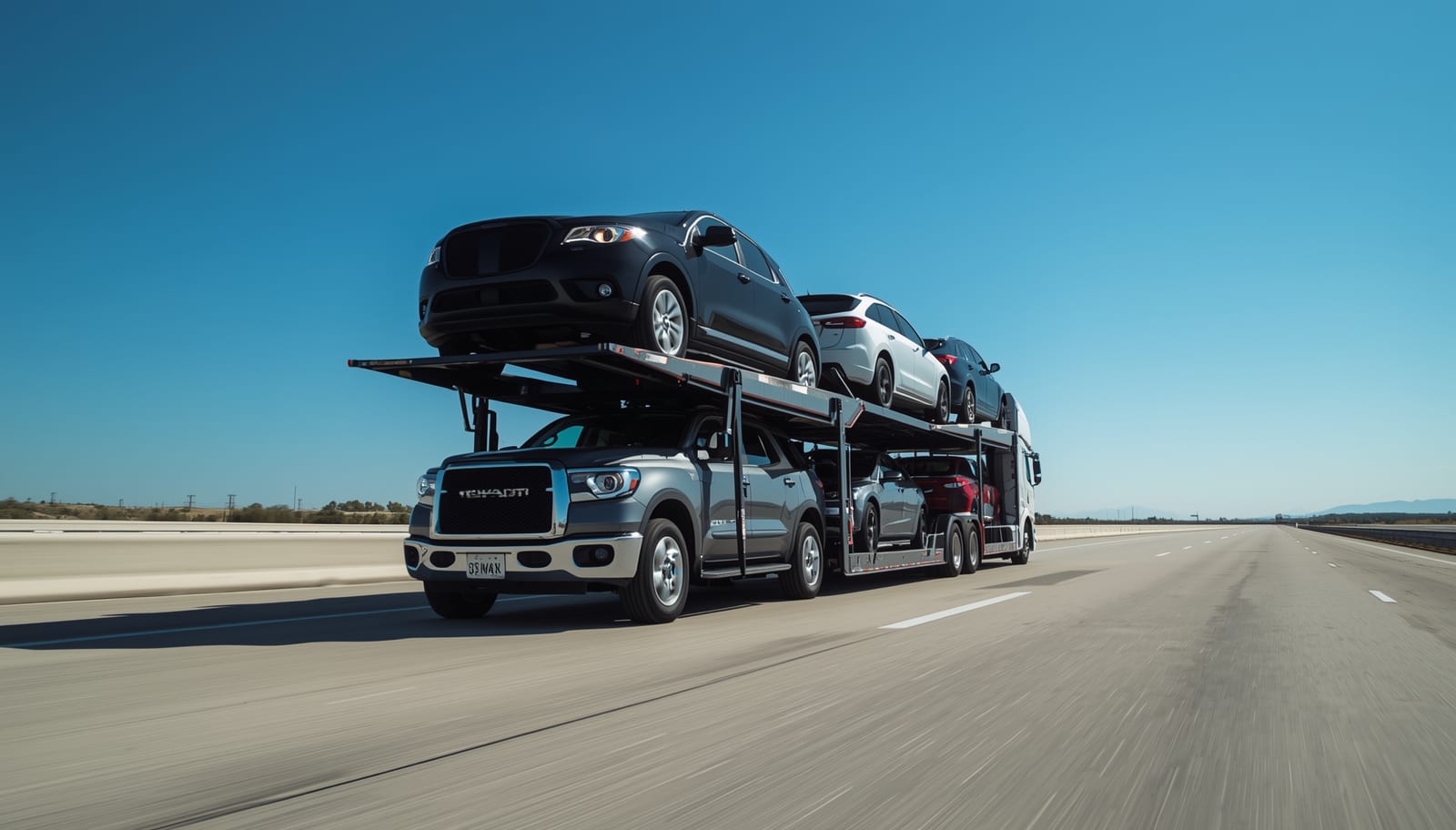
Ship a sedan and a full-size pickup on the same route, on the same day, and the pickup will cost more. That's not an arbitrary markup — it's about trailer space and weight. A car carrier earns its money per truckload, and bigger vehicles mean fewer vehicles per truckload.
This guide explains what drives the price difference, gives typical premiums by vehicle class, and shows a few ways to bring the cost down.
Free car shipping quote
What will it cost to ship your car?
Get Your Free Quote
Free quote in 60 seconds · We never sell your info
Three Reasons Bigger Vehicles Cost More
Length: A typical car carrier holds seven to ten vehicles. A crew-cab pickup can take the space of one and a half sedans, so fewer vehicles fit.
Weight: Trucks have a legal weight limit. Heavy SUVs and pickups use more of it, which can force the carrier to leave a spot empty.
Height: Tall vehicles can only go in certain trailer positions to stay under bridge clearances. That limits how the carrier can load the truck.
Example Quotes
Mid-size SUV, about 1,500 miles, off-peak: Typically around $1,050–$1,400 on an open carrier.
Full-size pickup, coast to coast: Typically around $1,500–$2,000 on an open carrier.
Heavy-duty dually, about 1,800 miles, summer: Often $1,700–$2,300, depending on dimensions and route.
These are estimates to show the pattern; your quote depends on your exact route and dates. Get yours in the car shipping calculator.
Want your actual price? Request a free quote in 60 seconds — no payment, no spam.
Get My Free Quote →Four Ways to Lower the Cost
- Widen your pickup window: Five days gives dispatchers room to find a truck with the right space.
- Ship off-peak: Avoid early summer and the January snowbird rush if you can. See the best time of year to ship a car.
- Meet near a major highway: A pickup point near an interstate or metro area can cut the price.
- Remove accessories: Roof racks, cargo boxes and bike racks add height and can push you into a higher price bracket.
How Season Affects SUV and Truck Pricing
Bigger vehicles feel seasonal demand more than sedans, because carriers have fewer spots that fit them. In busy months, a truck that needs a lower-deck position competes with every other large vehicle on the lane.
- Summer (May–August): The busiest moving season. Expect the highest prices and longer pickup windows.
- Snowbird months: Southbound lanes into Florida, Arizona and Texas fill from October through January; northbound lanes fill from March through May.
- Off-peak (September–November, February–April outside snowbird lanes): Usually the best time to ship a full-size SUV or pickup.
See the best time of year to ship a car for month-by-month details.
Shipping Work Trucks and Commercial Pickups
Contractors and businesses often ship work trucks with toolboxes, ladder racks or service bodies. These add weight and height, so share them at booking:
- Ladder and headache racks: Add height; may need a lower position.
- Toolboxes: Should be empty or very light. Carriers don't insure tools.
- Service bodies and flatbeds: Change the truck's length and weight; some need a flatbed or hotshot trailer.
- Fleet moves: Shipping several trucks together can lower the per-truck cost.
See truck shipping and multi-vehicle shipping.
Open or Enclosed for a Truck or SUV?
For most SUVs and pickups, open transport is the practical choice — these vehicles are built for the road. Enclosed makes sense for high-end SUVs like a Range Rover, G-Wagon or Escalade, or for a restored classic truck. Enclosed adds roughly 30–40% to the price.
Want your actual price? Request a free quote in 60 seconds — no payment, no spam.
Get My Free Quote →The Eight Vehicle Classes Carriers Price By
Car carriers think in terms of space and weight. Most quotes fall into one of these classes:
1. Compact cars (Civic, Corolla, Mazda3): The smallest and lightest; often at or slightly below baseline.
2. Mid-size sedans (Camry, Accord, Malibu): The industry baseline that most quotes are built from.
3. Full-size sedans and small crossovers (Charger, RAV4, CR-V): Slightly more space; a small premium.
4. Mid-size SUVs (Explorer, Highlander, Grand Cherokee): More height and weight.
5. Three-row and large SUVs (Tahoe, Expedition, Suburban): Long and heavy; often lower-deck only.
6. Half-ton pickups (F-150, Silverado 1500, Ram 1500): Length from crew cabs and beds is the key factor.
7. Heavy-duty pickups (F-250/350, Silverado 2500/3500, Ram 2500/3500): Heavy and long; diesel engines add weight.
8. Duallies, lifted and modified trucks: Width or height limits where they can ride; priced individually.
How to Estimate Your SUV or Truck Shipping Cost
A simple way to estimate is to start with the sedan price for your distance, then add the premium for your class:
- Start with the distance band: ShipMyCar US sedan pricing typically runs $400–$750 under 500 miles, $700–$1,050 for 500–1,000 miles, $950–$1,300 for 1,000–1,500 miles, $1,100–$1,500 for 1,500–2,000 miles and about $1,300–$1,800 coast to coast.
- Add the class premium: roughly $50–$100 for small SUVs, $75–$150 for mid-size SUVs, $150–$300 for full-size SUVs and half-ton pickups, and $300–$600 for heavy-duty trucks.
- Adjust for season: Summer and snowbird months can add $100–$300 on busy lanes.
- Adjust for transport type: Enclosed adds roughly 30–40%.
For an exact number, use the car shipping calculator.
A Worked Example
Say you're shipping a mid-size SUV 1,200 miles in October on an open carrier. The sedan band for that distance is about $950–$1,300. Add roughly $75–$150 for a mid-size SUV. October is off-peak for most lanes, so no seasonal premium. That puts the estimate around $1,025–$1,450.
Now say it's a crew-cab F-250 diesel on the same route in July. Start from the same band, add roughly $300–$600 for a heavy-duty truck, and allow $100–$300 for peak summer demand. The estimate lands around $1,350–$2,200. Same distance, very different vehicle and timing.
The Metro Hand-Off Trick
Large trucks and SUVs are hardest to place when the pickup is rural, because carriers have to leave the interstate with a tall vehicle that limits their load. If you can drive your truck to a nearby metro area or a spot near a major highway, carriers can pick it up without a long detour. That can shorten the pickup window and lower the price. Read car shipping rates by state.
Trailer Hitches, Tow Mirrors and Bed Accessories
- Hitches and ball mounts: Remove removable ball mounts; they add length and can contact other vehicles.
- Tow mirrors: Fold them in; extended mirrors can add width.
- Bed covers and caps: Hard caps add height — include them in your measurements.
- Running boards and steps: Usually fine, but power steps should be retracted.
- Bed contents: Empty the bed. Tools and cargo aren't insured and may not be allowed.
Why Weight Matters as Much as Size
A loaded car carrier can't exceed the legal gross weight limit, which is 80,000 pounds on most interstates. The truck, trailer, fuel and equipment take up a big share of that, leaving roughly 40,000–50,000 pounds for vehicles. A typical mid-size sedan weighs around 3,300 pounds, while a three-row SUV can top 5,500 pounds and a heavy-duty diesel pickup can exceed 7,000 pounds.
Put a few heavy trucks on one load and the carrier can hit the weight limit with empty spots still on the deck. Those empty spots are lost revenue, which is why heavier vehicles carry a premium even when they'd physically fit.
Height and the Upper Deck
Most car carriers have two levels. The upper deck offers the most spots but the least height clearance, because the loaded truck has to stay under about 13 feet 6 inches in most states. Tall SUVs, vans and lifted trucks often can't ride up top, so they compete for a limited number of lower-deck spots. When those fill up, the price for the next tall vehicle goes up.
More Ways to Save on Shipping a Big Vehicle
- Remove roof boxes, racks and light bars to bring the height down.
- Ship mid-week or mid-month, when demand is often lighter.
- Pair it with a second vehicle on the same booking.
- Avoid the first and last weeks of the month in summer, when many moves happen.
- Ask about terminal options if you're in a remote area.
Frequently Asked Questions
How much more does it cost to ship an SUV than a sedan?: Usually about $50–$150 more for small and mid-size SUVs, and more for full-size SUVs.
Why do pickup trucks cost more to ship than SUVs?: Pickups are often longer and heavier, especially crew cabs, long beds and heavy-duty models, so they take more trailer space and weight capacity.
Does it cost less per mile to ship an SUV a long distance?: Yes. Like any vehicle, the per-mile rate drops as distance increases.
How can I save on shipping a truck?: Be flexible on dates, ship off-peak, meet near a highway and remove roof-mounted accessories.
Do electric SUVs and trucks cost more to ship?: Often slightly, because they're heavier. See EV weight and carrier capacity.
Can I ship a truck with a lift kit on an open carrier?: Usually, in a lower-deck position. Give us the current height for an accurate quote.
Is enclosed transport available for large SUVs?: Yes, as long as the SUV's height and length fit the trailer. Most full-size SUVs fit.
How much does it cost to ship a Tahoe or Suburban?: Full-size SUVs usually cost roughly $150–$300 more than a sedan on the same route, depending on season and lane.
Source: every broker and carrier's operating authority, safety rating, and insurance status is public record — verify any company for free at the FMCSA SAFER System.
Related Articles
How Much Does It Cost to Ship a Car by Distance? 500 to 3,000 Miles
Shipping a Lifted or Modified Truck: Height Limits, Costs and Carriers