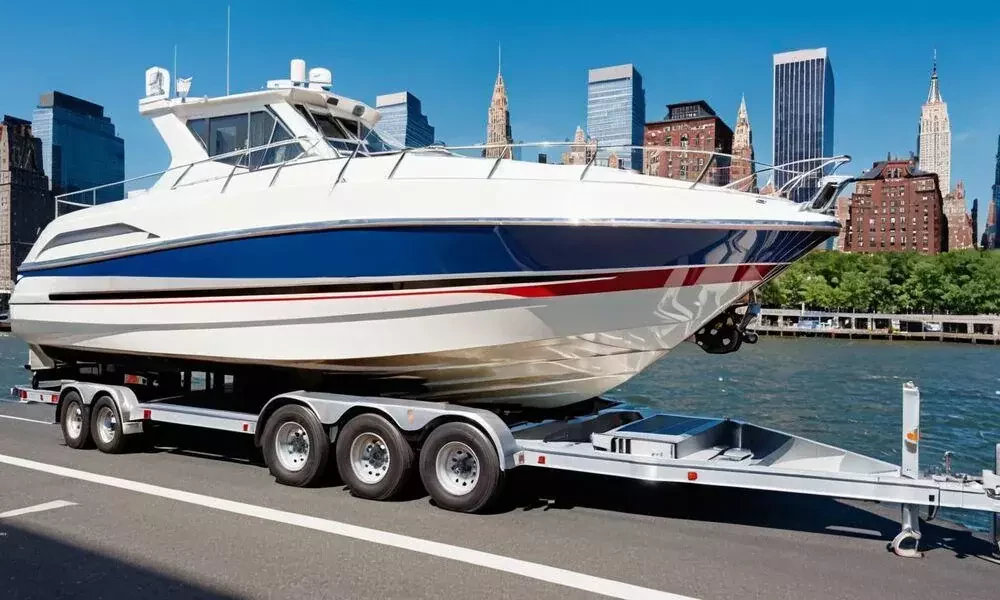
Boat shipping costs are harder to predict than car shipping costs. A 16-foot fishing boat on its own trailer and a 40-foot cruiser that needs an oversize permit can travel the same route at very different prices.
Use the calculator below for an instant estimate — enter your route, your boat's length and beam, and you'll see a price range in seconds, with no email or phone number required. The rest of this guide explains the per-mile rates behind that number, what yacht and sailboat transport costs, and how to lower your price.
Boat Shipping Cost Calculator
Instant estimate — no email or phone needed.
Enter your route or the distance to see your estimate.
Estimates use average per-mile boat hauling rates and are not a quote. Your final price depends on exact dimensions, height on the trailer, route permits, and season.
How Much Does Boat Shipping Cost?
Most boat transport is priced per mile, and the biggest factor in that rate is your boat's beam (width), because width decides whether the load needs permits and escorts.
Beam under 8′6″: About $1.25–$2.00 per mile, averaging around $1.63. No oversize permit is needed.
Beam 8′6″ to 12′: Roughly $2.00–$2.75 per mile, including state oversize permits.
Beam over 12′: About $2.75–$3.75 per mile or more, with permits and pilot or escort vehicles.
Length, height on the trailer, and weight move you up or down within each range. Very short trips are usually billed as a flat minimum rather than per mile, and long hauls tend to earn a lower per-mile rate.
Boat Shipping Cost by Distance: Quick Reference
If you'd rather skip the calculator, multiply your trip distance by a per-mile rate. The figures below use the $1.63 average for standard trailerable boats and $2.75–$3.75 per mile for boats with a beam over 12 feet.
250 miles: About $410 for a standard trailerable boat; $690–$940 for a wide-beam boat.
500 miles: About $815 standard; $1,375–$1,875 wide-beam.
1,000 miles: About $1,630 standard; $2,750–$3,750 wide-beam.
2,500 miles (cross-country): About $4,075 standard; $6,875–$9,375 wide-beam.
Treat these as ballpark figures. Permits, escort vehicles, and seasonal demand can push a quote higher.
How Much Does It Cost to Ship a Boat Across the Country?
Shipping a boat coast to coast covers roughly 2,500 to 3,000 miles. At average per-mile rates, that works out to about $4,100–$4,900 for a standard trailerable boat and $6,900–$11,250 for a wide-beam boat that needs oversize permits.
Because per-mile rates tend to fall on longer trips, a cross-country quote can come in below these figures. Booking in fall or winter, when demand drops, is the most reliable way to lower it.
Yacht and Sailboat Transport Costs
Yachts cost more to move than trailerable boats because of their size. Standard loads on US highways are capped at 8 feet 6 inches wide. Anything wider needs an oversize permit from every state on the route, and many states require pilot or escort vehicles once a load passes roughly 12 feet wide. Those permits and escorts are built into the per-mile rate, so overland yacht transport usually starts at the top of the range — $2.75–$3.75 per mile or more.
Sailboats: The mast is usually unstepped (taken down) and secured alongside the hull, and keel boats ride on a specialized hydraulic trailer. There may be a separate charge for mast handling on top of the haul.
Large yachts: Vessels too large for the road are usually moved by water, either under their own power with a delivery captain or as cargo on a yacht transport ship. Those moves are priced per project rather than per mile.
International boat transport: Shipping a boat overseas adds ocean freight, port fees, and customs clearance, so it is quoted separately from domestic hauling.
What Affects the Cost of Shipping a Boat
Beam and length: Width decides permits and escorts; length and weight decide the trailer and truck needed. Together they set your per-mile rate.
Height on the trailer: Most states limit loads to about 13′6″ tall. A tall boat may need towers, arches, or radar removed, or a route that avoids low bridges.
Distance and route: Longer trips cost more in total but less per mile. Routes through several states mean more permits for oversize loads.
Trailer: A boat that ships on its own roadworthy trailer is simpler to move. If the carrier has to supply a hydraulic or bunk trailer, expect a higher rate.
Season: Spring and early summer, when owners move boats to the water, are the busiest months. Fall and winter usually bring lower prices and faster pickup.
Extra services: Shrink-wrapping, mast unstepping, cradling, and storage add to the base haul.
How to Prepare a Boat for Shipping
Good preparation protects your boat and avoids delays at pickup. Before the carrier arrives:
- Take dated photos of the hull, deck, and trailer from every side
- Remove personal items, loose gear, and electronics
- Take down antennas, outriggers, and anything that raises the overall height
- Remove or tightly secure canvas, bimini tops, and covers — loose canvas can shred at highway speed
- Run fuel down to about a quarter tank and drain water and holding tanks
- Disconnect the batteries and secure the engine or outdrive
- Latch hatches, windows, and doors and tape any that could open
- If the boat ships on your trailer, check the tires, bearings, lights, and tie-down straps
Have the keys and any registration paperwork ready for the driver, and walk around the boat together to note its condition on the Bill of Lading.
What a Boat Shipping Quote Should Include
A calculator gives you a budget. A firm quote should spell out:
Total price: The full cost, including any permit and escort fees, not just a per-mile rate.
Carrier credentials: The hauler's USDOT and MC numbers, which you can check on the FMCSA website.
Insurance: A certificate of insurance showing cargo coverage high enough for your boat's value.
Pickup window and transit time: A realistic range, especially if permits have to be issued first.
Payment terms: How much is due before pickup, if anything, and how the balance is paid.
Point of contact: One person who can give you updates while your boat is on the road.
How to Choose a Boat Transport Company
The cheapest quote isn't always the best one. A lowball price can mean a carrier without the right trailer or permits, which leads to delays. When comparing boat transport companies, look for:
- Experience with your type of boat — a pontoon, a center console, and a keel sailboat each need different handling
- Clear pricing that lists permits, escorts, and extra services
- Active FMCSA authority and cargo insurance that covers your boat's value
- Recent reviews from other boat owners
- Straight answers about pickup timing and who to contact in transit
ShipMyCar US arranges boat transport through vetted carriers with the right trailers and permits for your boat. Use the calculator above for an estimate, then call us for a firm quote.
How to Lower Your Boat Shipping Cost
Ship in the off-season: Fall and winter usually bring lower rates and more carrier availability.
Be flexible on dates: A wider pickup window lets a carrier fit your boat into an existing route.
Reduce the height: Removing towers, arches, or radar can keep your boat under height limits and avoid a longer route.
Use your own trailer: If your trailer is roadworthy, shipping on it avoids the cost of a carrier-supplied trailer.
Do the prep yourself: Handling shrink-wrap, canvas, and loose gear before pickup avoids extra service fees.
Ship more than one boat: Some carriers discount multiple boats moving on the same route.
Compare complete quotes: Make sure every quote includes the same permits and services so you're comparing like for like.
Source: every broker and carrier's operating authority, safety rating, and insurance status is public record — verify any company for free at the FMCSA SAFER System.