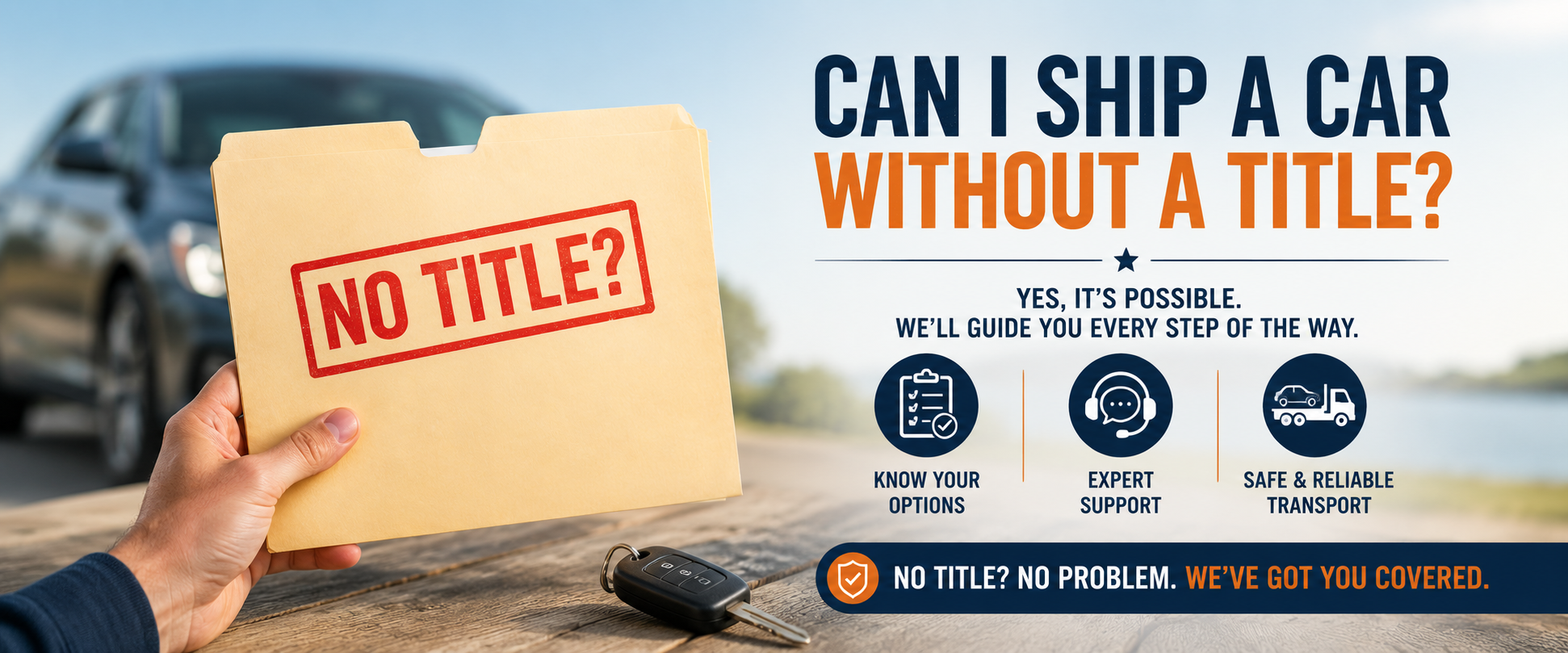
If you're wondering whether you can ship a car without a title, you're not alone — it's one of the most common questions in auto transport. The short answer is yes, it's possible in some cases. Whether your title is lost, delayed, or held by a lender, there are legal workarounds depending on your situation.
In this guide, we break down your options, the alternative documents most carriers accept, how requirements vary by state, and what to do before you schedule pickup so nothing holds up your shipment.
Can I Ship a Car Without a Title? Here's Why It's Usually Required
In most situations, title and registration requirements for car shipping are strictly enforced. The title is the legal proof of vehicle ownership, and carriers need it to verify that you're authorized to transport the vehicle.
The title also confirms essential details like the VIN, make, model, and ownership history — all of which are critical to insurance coverage, transport contracts, and federal compliance. It's the primary document carriers rely on, especially for cross-state or long-distance moves.
That said, if you don't have the title in hand, there are legal alternatives in specific situations. Let's look at when shipping without a title is permitted and how to do it the right way.
When You Can Ship a Car Without a Title in 2025
While most shippers require proof of ownership, there are specific situations where you can legally and safely ship a car without the physical title.
The title is lost or damaged: Most carriers will accept a notarized Bill of Sale, your current vehicle registration, and a state-issued photo ID. You'll still need to apply for a duplicate title through your state DMV, but transport can often proceed while that's in process.
You recently purchased the car: A dealer invoice, purchase agreement, or temporary tag is accepted in many cases. This is one of the most common scenarios people face when asking what documents they need to ship a car without a title.
The car is financed or leased: If your bank or leasing company holds the physical title, you can usually ship the car by providing a lien release letter, a written authorization to ship, or a power of attorney. Some carriers will contact the lienholder directly to confirm authorization.
Shipping a salvaged or auction vehicle: For inoperable or salvaged cars, a salvage certificate, auction invoice, or signed receipt from the seller may be acceptable substitutes depending on the carrier.
In all cases, confirm with your carrier which documents are required before scheduling. Requirements vary by state and by individual carrier policy.
What Documents Do I Need to Ship a Car Without a Title?
If you're unable to provide a title, you'll need to supply alternative proof of ownership. Most carriers will request a combination of the following.
General documents accepted in place of a title:
- Vehicle registration (current or recently expired)
- Notarized Bill of Sale
- Copy of your driver's license or state-issued photo ID
- Proof of insurance
- Lien release letter (if the vehicle is financed)
- Dealer invoice or purchase agreement (if newly purchased)
Additional documents sometimes required:
- Power of attorney (if you're acting on behalf of the legal owner)
- Temporary operating permit or paper tags
- Written letter from the lienholder authorizing shipment
- Salvage certificate (for totaled or auction vehicles)
Each carrier may have slightly different policies, so confirm requirements before scheduling pickup. This avoids last-minute delays on the day your vehicle is due to be loaded.
Title Rules by State: What You Need to Know Before Shipping
Whether you can ship a car without a title also depends on where you live or where the vehicle is currently located. Each state has different DMV policies regarding title and registration requirements when the title is missing, in transit, or held by a lienholder.
States with lenient duplicate title policies: States like California, Texas, and Florida allow you to request a duplicate title quickly online or in person. Shipping can usually move forward if you show proof that the replacement is in process.
Strict states that require a physical title: States like New York, Illinois, and Massachusetts may not permit car shipping without an original or valid replacement title on file. Some carriers in these states won't pick up the vehicle unless a title is confirmed present.
Lienholder states: In states where lienholders retain the physical title — such as Georgia or Louisiana — you'll need to submit a lien release, shipping authorization, or power of attorney to the carrier before pickup can be scheduled.
Always check your state's DMV website for the exact instructions, or call the DMV directly if you're unsure what documentation is required in your specific situation.
What Happens If You Try to Ship a Car Without Proof of Ownership?
Attempting to ship a car without a title and without any proof of ownership can result in legal trouble or serious shipping delays — and most reputable carriers will refuse service entirely.
Carriers are required by law to confirm that you're the legal owner or have explicit permission to act on the owner's behalf. Without documentation, your vehicle could be flagged for:
- Potential vehicle theft
- Title fraud
- Insurance violations
If you're missing all three — title, registration, and bill of sale — you likely won't be able to ship the car until you go through your state DMV to establish legal ownership. This isn't just a carrier policy; in many cases it's a federal compliance requirement.
What you can do: Apply for a duplicate title or bonded title through your state DMV. Obtain a notarized Bill of Sale from the seller. Request a letter of authorization from your lienholder if the vehicle is financed. Provide temporary ownership documents if the vehicle was recently purchased at a dealer or private sale.
Final Checklist: What to Do If You Don't Have a Title Yet
If your title isn't available when you're ready to ship, here's exactly what to do before scheduling pickup.
If you don't have a title, you should:
- Apply for a duplicate title through your state DMV right away
- Gather alternative documents: registration, notarized Bill of Sale, or lien release
- Confirm your identity matches the vehicle records on file
- Ask your shipping company which specific documents are required for your situation
- Keep copies of everything — both physical and digital backups
- Notify the carrier upfront if your title is still in process or held by a lienholder
Most U.S. carriers require some form of ownership proof, even for domestic shipments. The more organized you are before scheduling, the smoother pickup and delivery will be.
In short: yes, you can ship a car without a title — but only if you have valid alternative documents that prove ownership, such as a registration, bill of sale, or lienholder authorization. If you have no proof of ownership at all, most carriers legally cannot move the vehicle until your paperwork is resolved. Reach out to the ShipMyCar US team for guidance on your specific situation, and we'll walk you through your options.
Source: every broker and carrier's operating authority, safety rating, and insurance status is public record — verify any company for free at the FMCSA SAFER System.